E-commerce Development
An e-commerce website that turns visitors into orders.
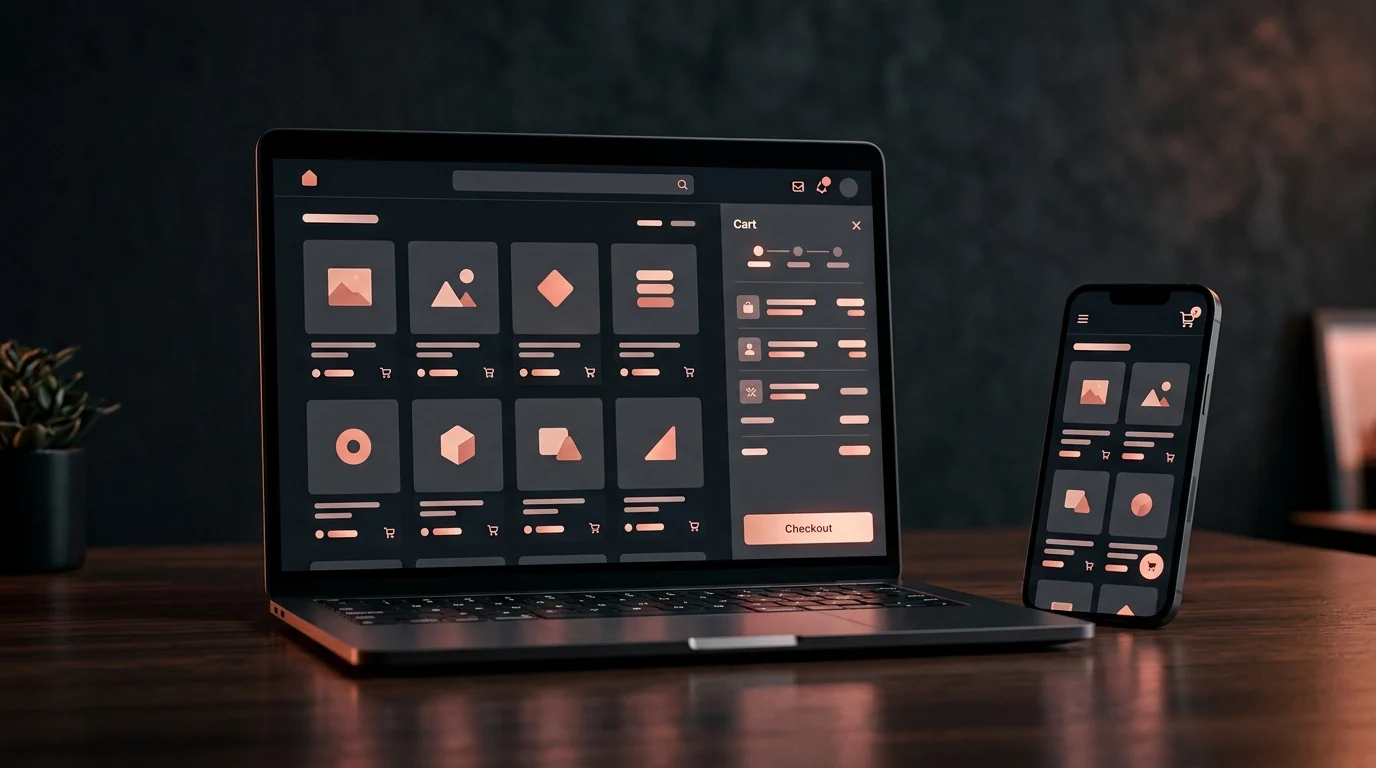
An online store to sell your products, with payments and delivery. Most stores lose sales between the product page and the finished order. We design that part carefully, then keep improving it.
Platforms & technologies we build on








Is this for you?
It is, if one of these sounds like you.
- People visit your store, but few of them buy
- You sell on marketplaces and want a store of your own
- Your products have too many options for a basic template
- You match stock and orders by hand
Sound familiar?
Why people come to us.
People leave at the checkout
Usually because of surprise delivery charges, being forced to create an account, too many form fields, or a missing payment option like UPI.
Customers cannot find the right product
Once you have more than a few products, search and filters are how people shop. If they are weak, fewer people buy.
The product page does not answer their question
Size, material, delivery time, returns. Every unanswered question is a reason to leave and not come back.
Stock and orders are handled by hand
Selling items you do not have, or matching orders in a spreadsheet, means your store is not connected to where your stock is tracked.
Which one do I need?
Website, app or software: which do I need?
Web Development
Choose this if you want people to find your business online, see what you offer and contact you.
For example: A clinic website with its services, doctor profiles and an appointment form.
About Web DevelopmentE-commerce
This pageChoose this if you want to sell products online and take payments.
For example: A clothing brand's online store, with UPI and card payments and delivery tracking.
Web Applications
Choose this if your customers or staff need to log in to do something, like book, track or manage.
For example: A coaching institute portal where students log in to see classes, fees and results.
About Web ApplicationsCustom Software
Choose this if you need a tool to run your own business, like billing, stock, staff or customer records.
For example: Billing and stock software built around how your shop actually works.
About Custom SoftwareSaaS Development
Choose this if you want to build software that other businesses sign up for and pay for every month.
For example: A booking app that many salons pay a monthly fee to use.
About SaaS DevelopmentMobile Apps
Choose this if your customers use you often and would install an app on their phone.
For example: A restaurant's ordering app with saved addresses and order history.
About Mobile Apps
What you get
What we do for you.
Choosing the right platform
Shopify, WooCommerce or a custom build, chosen by how many products you sell, how many orders you get, and who will run the store.
Store design
Category, product, cart and checkout pages designed as one journey, in your brand's look.
Product pages that answer questions
Search, filters, sizes and colours, photos, reviews, and the details that answer questions before people have to ask.
An easy checkout
Buying without an account, fewer fields, the total cost shown early, and the payment methods your customers use.
Payments, delivery and tax
Payment gateway, UPI and wallets, delivery rules and tax set up for the places you sell to.
Connected to your stock and accounts
Your stock, accounting and delivery apps connected, so orders flow through without being typed in again.
Example
What this could look like for a home-décor brand selling on Instagram.
A typical case, to show the kind of change this makes. It is an example, not a client story.
Before
Orders arrive as Instagram messages. Payments are chased one by one, and stock is tracked in a notebook.
After
An online store with UPI and card payments, delivery tracking, and stock that updates itself. Orders can come in at any hour.
How it works
Step by step.
- 01
Review
We look at your current sales, your product range and how orders are handled today, to find where sales are lost.
- 02
Plan
Which platform, how products are organised, what connects to what, and how existing products and customers move over.
- 03
Design and build
The whole buying journey is designed together, then built and tested with real test orders.
- 04
Launch and improve
We move your products, keep old product links working, and watch the first days of sales closely. Then we keep improving from what the sales show.
How long it takes depends on what is included. We give you a timeline before any work starts.
What you have at the end
- A platform recommendation, with reasons
- A clear way of organising your products
- A designed and built online store
- Payments, delivery and tax set up
- Stock and accounting connected
- Sales tracking, and a guide to running the store
In more detail
How someone buys from your store
Most stores design these as separate pages. Customers see them as one decision, and the gaps between them are where orders are lost.
- 01FindingSearch, categories, suggestions
- 02Product pageAnswering their questions
- 03CartTotal cost shown early
- 04CheckoutNo account needed, few fields, UPI
- 05OrderConfirmation and delivery date
- 06Coming backWhere the profit is
Price and timeline
What it costs.
Every project is priced on what it needs. Tell us your needs for an exact quote, with no obligation.
Ways to work with us
Fixed project
A clear result, with a clear finish line.
Monthly marketing
Marketing, social media and SEO that build up month after month.
FAQ
Questions about E-commerce
Shopify or WooCommerce?
Shopify suits you if you want hosting, payments and updates handled for you, and you value simplicity. WooCommerce suits you if you already use WordPress or need unusual rules. A fully custom store only makes sense at high volume, or with very unusual needs.
Can you move our existing store?
Yes: products, options, customers, orders and content. We keep old product links working, so the Google rankings you have built come across with you.
Can you improve our current store instead of rebuilding it?
Often, and it is usually better value. We look at where people drop out, then fix the biggest problems first. We would rather tell you the checkout needs three changes than sell you a new store.
Do you do product photography?
Not ourselves. We will tell you what is needed and work with your photographer, or introduce you to one. Good photos are one of the biggest things that help a store sell.
Related services
Often needed together.
- Get a websiteWeb DevelopmentYou need this when you need a website that explains what you do and brings enquiries.
- Get more customersPerformance MarketingYou need this when you want paid ads on more than one platform, measured together.
- Get more customersSEOYou need this when you want free visits from Google that keep coming.
For technical teams: what we build this with
Chosen for each project. If your team already uses something that works, we would rather build on it than replace it.
Shopify
Commerce where the operational simplicity of a hosted platform outweighs the constraints it imposes.
WooCommerce
Commerce built into an existing WordPress site, where content and catalogue need to live together.
Next.js
Server rendering, routing and image optimisation. It is what lets a site be visually rich and still load quickly on a mid-range phone.
TypeScript
Our default for anything non-trivial. Types catch a whole class of bug before it reaches a review, and they make handover to another team realistic.
Stripe
Subscription billing, trials, proration and invoicing for SaaS products, on an account the client owns.
Razorpay
Payments for Indian businesses, including UPI and the local payment methods customers here expect.
Google Analytics 4
Behaviour and conversion measurement, configured with events that map to your funnel rather than left on defaults.
Meta Ads
Facebook and Instagram campaigns, where creative rather than targeting does most of the work.

Talk to us about E-commerce
Tell us what you need. We will reply with questions, a suggested plan, or an honest answer if E-commerce is not right for you.
Or email us directly at support@thedigitalalchemy.co.in